Learning is not in your head
An alternative approach to learning

Youth coaches
When I was younger, I remember coaches telling me things like:
Just think about it.
Get it in your head.
Are you even listening?
Just pay attention.
Yes, I am paying attention.
Of course, I'm thinking about it.
There were countless times when I got frustrated at my coaches for moaning about things, that made no sense to me.
Skipping the life story, I learned something during my undergraduate degree.
I knew everyone had assumptions.
We all do.
But, I learned new assumptions in how we think about learning.
Assumptions that could explain my frustrations.
The main assumption I want to discuss in this article; learning is in your head.
Traditional learning
It works. It's intuitive. It just makes sense.
All things I used to tell myself.
That is where memories are stored, and where the processing happens.
Well...
This is where my understanding was challenged.
The assumption; we sense, we process, and then we act.
Using CUE as an example.
CUE being a basketball shooting robot.
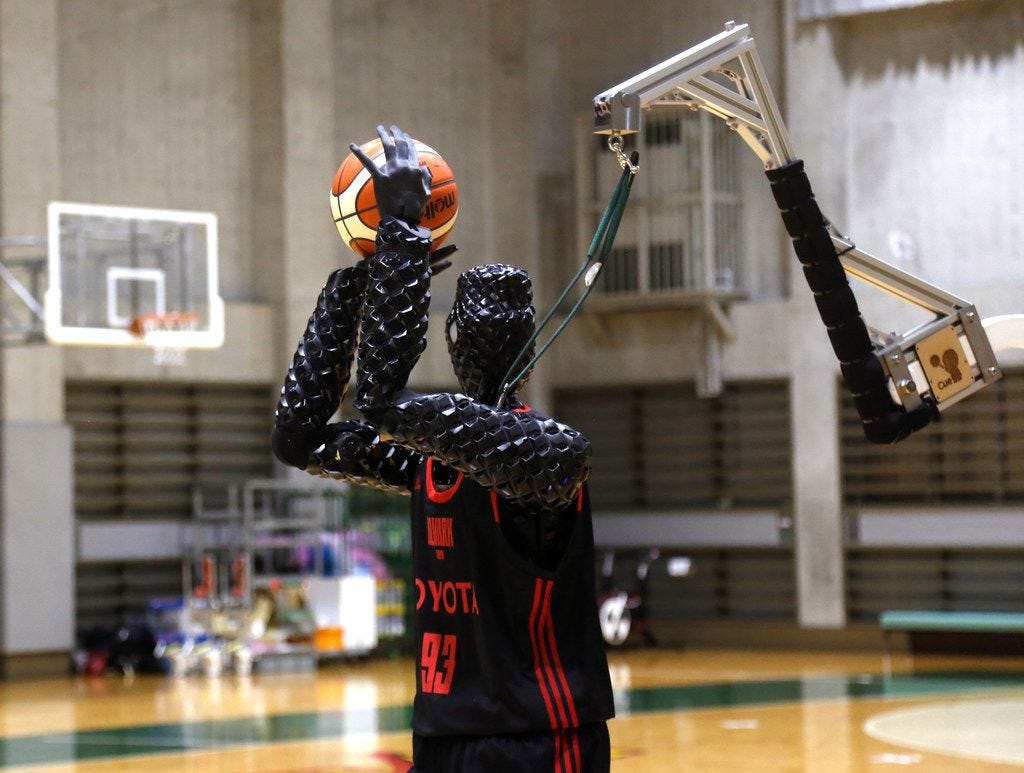
Humans give CUE data to use. It senses.
CUE uses artificial intelligent calculations. It processes.
Then CUE executes a series of movements. It acts.
Stage of learning
A popular model from my school days was the Fitt's and Posner model.
It suggests 3 stages:
Cognitive
Associative
Autonomous
As you learn, you move up through the stages with less cognition on your skill.
Advanced individuals will be autonomous in their skills, requiring little or no thought about their skill.
Promoting a linear view of learning, from stage 1 - 3.
However, linear learning has been challenged; Rob Gray sharing his thoughts in this video with various others challenging the idea.
We assume action programs are stored in our head.
Being executed after the processing step.
If we improve the processing, we move up the stage in this model.
We assume we need our brain to add context, from things like memory, to process and then act.
Because we don't sense enough information.
But what if we do?
An alternative view
James Gibson is a figurehead of this idea.
The idea of direct perception.
Traditional explanations of perception discuss impoverished images that we sense.
Indirectly perceiving, as we require our brain to add context.
But James suggested we get all the information we need, we directly perceive our environment.
Instead of needing the brain to give context, we perceive opportunities for action, termed affordances.
The action program is then no longer stored in the brain.
Learning moved out of the brain, and into the relationship between the organism and environment.
Person and environment.
Learning or developing expertise can then be explained in different ways:
Attunement to affordances.
Sensitivity of affordances.
Awareness of constraints.
This relates heavily with the constraints led approach to coaching.
Application
Direct perception is not an idea many will grasp straight away.
It took me a while.
But the related ecological approach opens up an alternative view of learning.
Educator behaviours could change.
Learner interpretations of development could change.
And most importantly for me, was the understanding that:
Memory isn't the problem
Brain capacities or limits aren't the problem
Intelligence isn't the problem
Expertise is in the relationship between the person and environment.
My brain wasn't the problem, there is far more to the story.
And that is what i'm learning about.